
1 file
What we were handed
A four-page Illustrator file with a logo and a swatch row — nothing else.
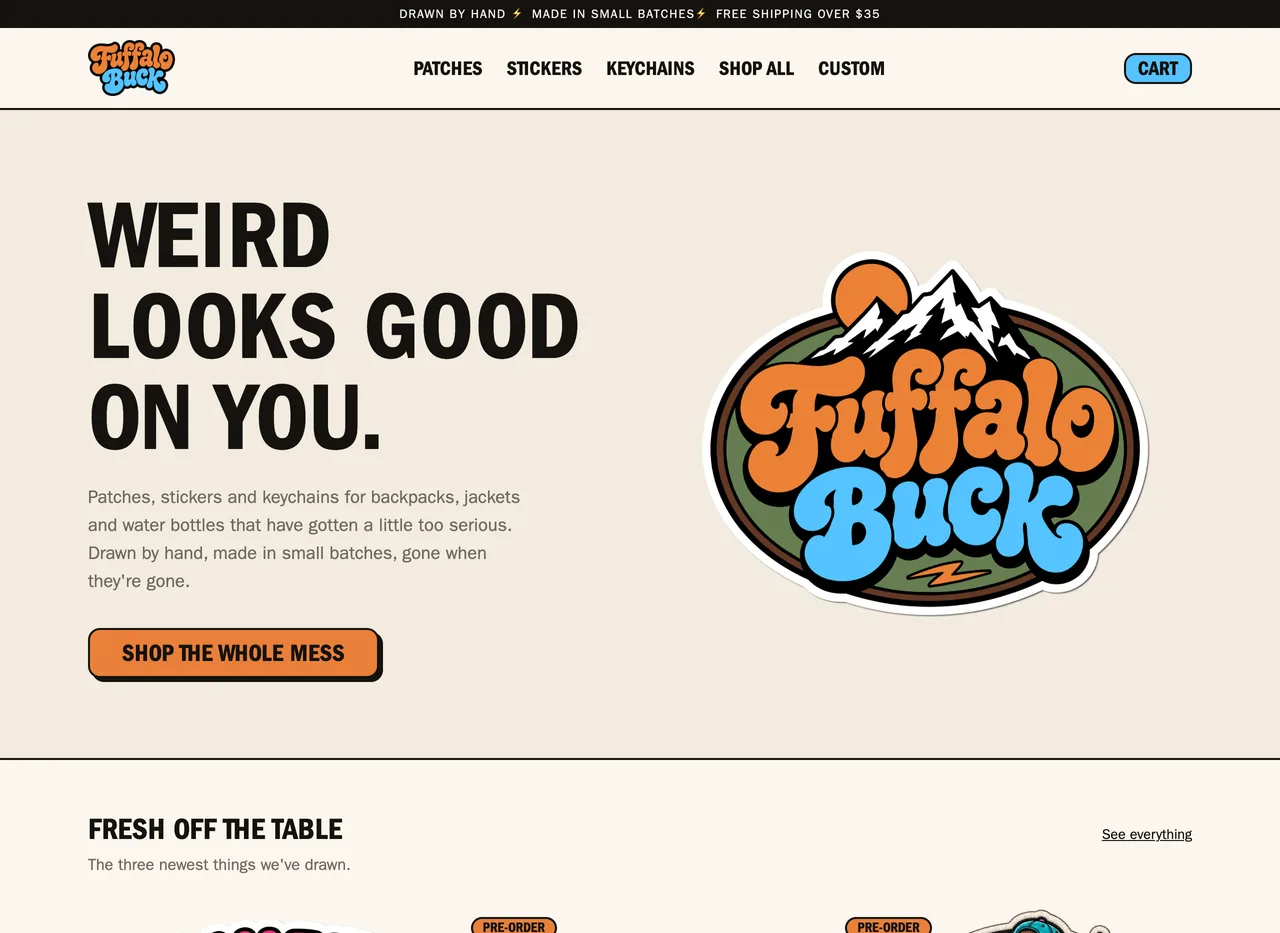
Fuffalo Buck is an Omaha outdoor-humor brand — original artwork, small runs, a founder who draws everything himself. It arrived as a single Illustrator file, a font licence, and a domain that wasn’t registered yet. No store, no palette, no photos, no copy. Ten days later it was a headless Shopify storefront on its own domain: taking money, publishing itself when a product is added, and quoting custom manufacturing work.
The commercial constraint shaped everything. Patches sell for $12, stickers for $4.99 — at that price a storefront can’t carry a monthly platform bill or a per-order app tax, and it can’t afford to lose a sale to a slow page.
The brand arrived with “Weird stuff for weird people.” A good line with a problem: it makes the customer audition. We rewrote it — “Weird looks good on you.” Same attitude, opposite direction: it hands the reader the compliment instead of asking them to qualify for one.
A storefront that costs almost nothing to run, publishes itself, and does what the platform won’t — with the checkout left to Shopify, where it belongs.
The brand arrived as a single Illustrator file. Rather than eyeball colors from a screenshot, we rendered the artboards and sampled the exact swatches the illustrator had already drawn — so every brand color on the site is the exact value from the source file, not an approximation. When white text failed contrast on the brand orange, we used ink-black instead — the choice the artwork itself had already made.
Every page is prerendered and served from the edge. Exactly one thing runs per request — a small isolated component holding live price, stock, and the buy button. Checkout stays on Shopify, so payments, tax, fraud, and PCI are never the store’s problem, and a drop-ship traffic spike costs almost nothing to absorb.
The cart drawer, product gallery, reward meter, and quote form together ship 12 KB of JavaScript — because $4.99 stickers can’t afford to lose a sale to a slow page or carry a monthly platform bill. Product pages respond in about 180 milliseconds.
The founder is the illustrator, the packer, and the customer-service desk — so anything requiring a terminal would eventually stop happening. Now, adding a product in Shopify rebuilds and redeploys the whole site automatically — live in about ninety seconds, with a guard that fails loudly if the catalogue ever looks wrong.
Beyond the catalogue, a custom-manufacturing quote flow for embroidered, PVC and metallic runs — intake stored durably before it’s ever emailed — plus a two-stage reward meter (free shipping at $35, a free sticker pack at $50) that mirrors real Shopify discount rules rather than claiming them. If a discount is ever removed, the cart tells the truth instead of charging for a “free” gift.
Before launch we caught two silent killers: every single-variant product was unbuyable (most of a sticker catalogue), and the main shop link was serving a blank page as a 200. Neither threw an error or a log line — both were found by walking the actual buy path, and fixed so those failures now break the build loudly instead of shipping a hole.
Fourteen products across three categories, a working checkout on the brand’s own domain, and a build the founder can extend by adding a product and walking away.
Whether it’s thin margins that can’t carry app taxes, a founder who can’t babysit a dashboard, or a workflow no template supports — that’s the build we do. Fast, owned, and engineered around your actual business. Let’s talk about yours.