
A storefront that verifies its buyers before checkout.
PoliceOfc.com manufactures custom badges and insignia for law-enforcement agencies. We built a headless commerce storefront: the entire catalog prerendered to the edge, with only live price and inventory running per request. Checkout stays on Shopify, so the store never touches PCI scope. Then we solved the part the platform couldn’t — restricted federal insignia can only be sold to verified personnel, so the build gates those items behind an agency-credential upload, enforced server-side.
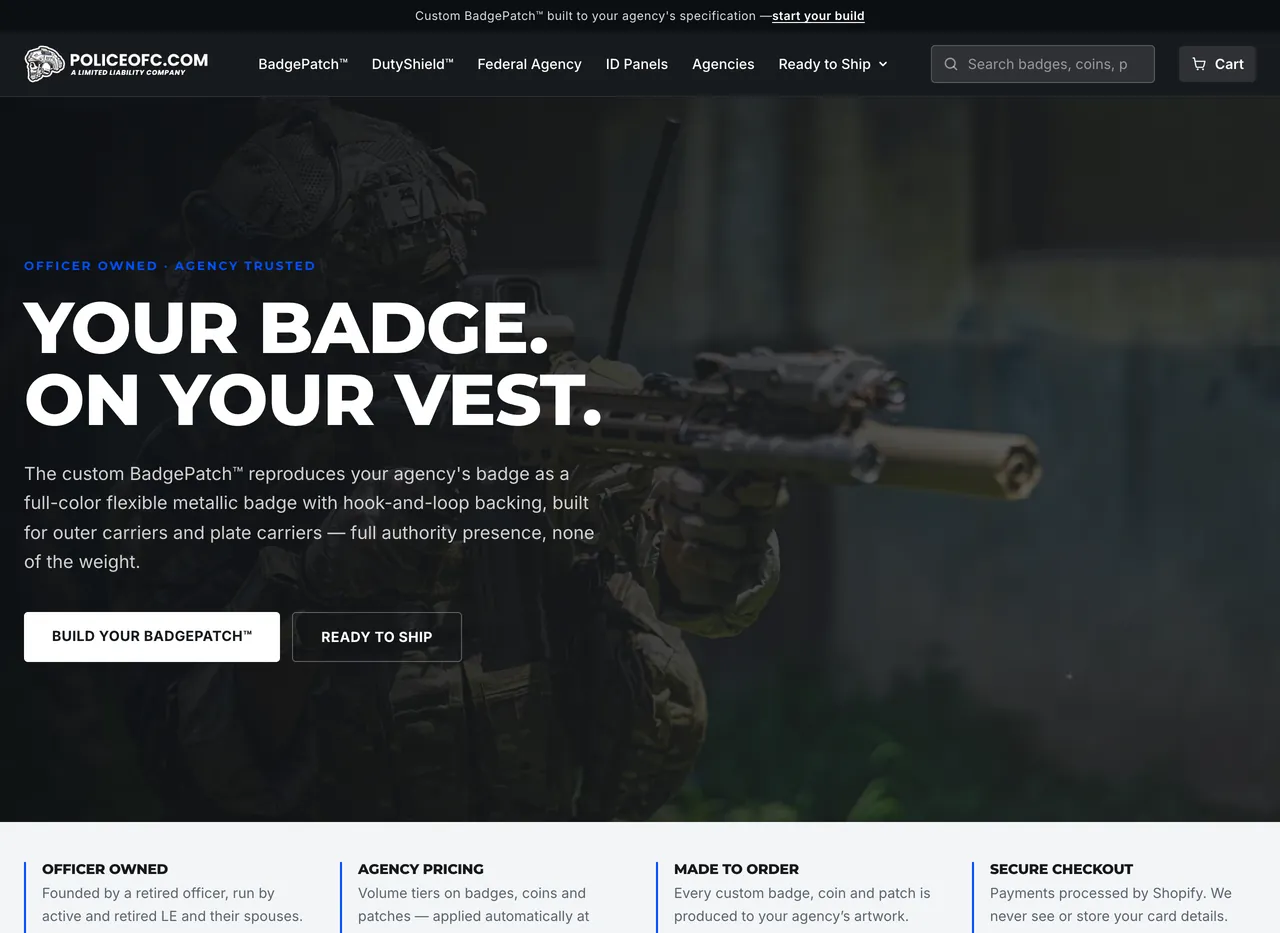
Selling restricted federal insignia means proving who’s buying.
Certain badge designs can only be sold to verified agency personnel — a real-world requirement the commerce platform simply doesn’t support out of the box. So we built it.
The platform couldn’t do it
On a standard theme, an upload is a one-line file input. The headless API has no file type at all, and its cart fields are plain strings. We proved the limitation by introspecting the live schema — not trusting the docs — then built the missing capability from scratch.
Upload, attach, verify
Restricted items require the buyer to upload agency credentials before the item can enter the cart. The file is stored, attached to the order as a line-item property, and validated by its actual contents — magic bytes — not the browser’s claimed file type.
Enforced where it can’t be bypassed
The gate runs server-side against each product’s restriction tags, so the requirement holds even if someone tampers with the page. A restricted badge can’t reach checkout without clearing verification — no client-side trick gets around it.
Built on current auth
Authentication uses the platform’s current credential-grant flow — the replacement for the static tokens retired in early 2026 — so the integration runs on what’s supported now, not what’s about to break.
Most headless builds are a rendering exercise. This one had a regulatory constraint the platform actively couldn’t satisfy — so we built the capability it was missing.
Static everywhere it can be. Live only where it must.
Not a default — a position. Prerender everything, and run only what genuinely has to be fresh. It’s a call you can explain in one sentence and defend for ten minutes.
Prerender the whole catalog
Every product page is static and served from the edge, so it appears instantly — no server waiting to render a page a thousand customers see unchanged.
Live only where it counts
A single isolated component fetches current price and stock at request time. Nothing else on the page waits on it — the fast 95% never pays for the live 5%.
Secrets never reach the browser
Cart actions proxy through a server-side edge endpoint, so the private commerce tokens stay on the server and never touch the client.
A cart that earns its weight
The cart is lightweight, framework-free JavaScript — because a shopping cart doesn’t justify shipping 40 KB of framework before the first product even renders.
The unglamorous work that makes a store actually sell.
A storefront is only the visible half. These are the parts that decide whether it makes money.
Full GA4 e-commerce tracking
The complete funnel — item views, cart adds, checkout starts, search terms with zero-result tracking, and list impressions fired on visibility, not render — with cross-domain linking to the hosted checkout, without which every sale misattributes as a self-referral.
Zero-downtime domain cutover
Moved the domain onto a custom edge domain with no downtime and not one dropped email.
Email that actually lands
Rebuilt sender authentication (SPF / DKIM / DMARC) and redesigned the order, shipping, and invoice notifications so they read like the brand — not the platform default.
A full SEO layer
Organization, Product, FAQ, and Article structured data, plus agency-specific long-tail content built to get found by search and AI alike.
Need a store that does what the platform won’t?
Most storefronts are a rendering exercise. When your business has a real constraint the platform can’t handle — compliance, verification, a workflow nobody else supports — that’s the build we do. Let’s talk about yours.