
AI Web Design: What It Really Means for Your Business in 2026
Your last website probably took three months to build, cost more than it should have, and still loads like it's dragging an anchor.
That era is over.
"AI web design" gets thrown around to mean everything from $12-a-month template engines to genuinely modern, custom builds — and the confusion is costing business owners real money. So let's cut through it. AI has changed web design on two fronts that actually matter to you: how fast a genuinely custom, high-performance site can be built, and how your customers find you now that many of them ask an AI instead of scrolling Google.
This article breaks down what that means for your business, and how to tell a real modern build from a cheap template dressed up in buzzwords.
What "AI Web Design" Actually Means (And What It Doesn't)
Let's clear something up first, because the term gets abused.
AI web design is not:
- A template generator that spits out the same site as your competitor with different colors
- A chatbot writing your homepage while nobody checks whether it's true
- A $12/month "AI website builder" that locks your business into a platform you don't own
AI web design, done right, is a custom site engineered for two audiences at once: the humans who buy from you, and the search engines and AI assistants that increasingly decide who gets recommended. It's built by people who set the strategy, make the judgment calls, and own the quality bar — not spat out by a machine and shipped before a human ever reads it.
The difference isn't the tools. It's the standards.
Why the Old Way of Building Websites Was Broken
If you've hired a web agency before, you know the traditional timeline: discovery meetings, wireframes, weeks of design revisions, months of development, and a launch date that slides at least twice.
Here's what that process actually cost you:
Time. A 12-week build is 12 weeks your competitors are collecting the leads you're not. For a service business, that's not an inconvenience — it's revenue walking past your door.
Money. Most of a traditional build's budget goes to repetitive production work — coding page variations, formatting content, wiring up forms. You were paying senior rates for junior tasks.
Quality tradeoffs. With the clock and budget burning, agencies cut corners where clients can't see: bloated page builders, third-party scripts, skipped performance work. That's how you end up with a site that looks fine in a screenshot and loads in four seconds on a phone. And Google's own Core Web Vitals data is blunt about what slow load times do to both rankings and conversions.
A modern build attacks all three at once — if the team knows what they're doing.
What a Modern, High-Performance Build Gets Right
Forget the buzzwords. Here's what separates a site built to the current standard from a template, stage by stage.
1. Research and strategy — done deeper, not skipped
Before a pixel gets placed, the market gets mapped: what your competitors rank for, what searches actually turn into booked jobs, and where the gaps are. One of our clients, a marine contractor, was sitting on a market of 6,764 monthly searches while capturing just 12 clicks a month. Finding that gap wasn't magic — it was research, done properly.
2. Hand-built performance — custom code, zero bloat
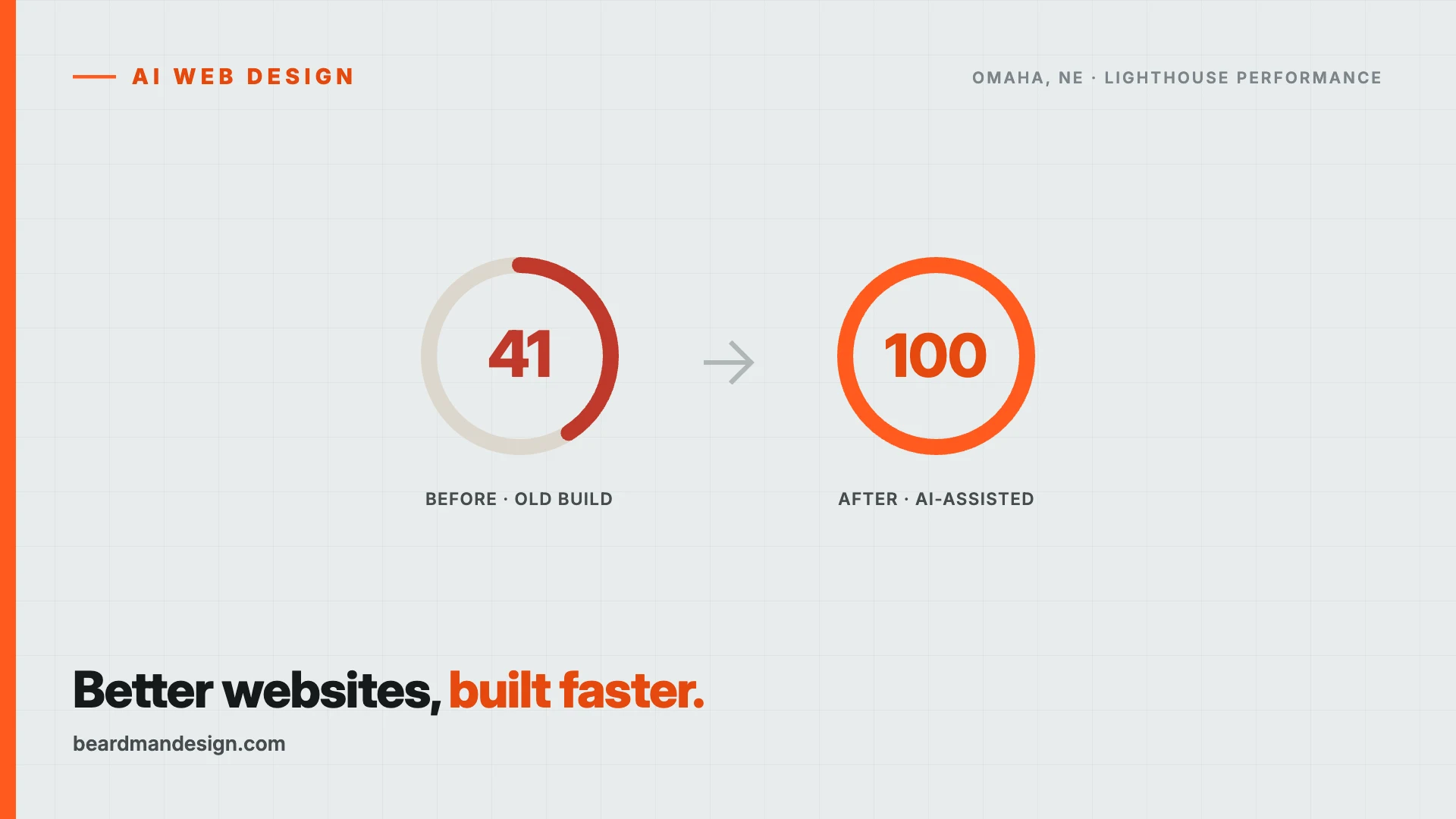
This is the big one. A site built to the current standard is hand-crafted custom code — no page builders, no plugin pile, none of the two megabytes of junk a template ships before your logo even appears. The proof shows up in the numbers Google measures: that marine contractor's rebuild went from a 41 to a 100 Lighthouse performance score — first paint in a fraction of a second, zero third-party scripts slowing it down. Speed like that isn't cosmetic; it's a ranking factor and a conversion factor at the same time.
3. Content and local SEO — scale without the sameness
Local service businesses win on local pages: one for each service area, each service line, each question your customers actually ask. The discipline part: every page has to be true, specific, and useful. Google's guidance is clear — it rewards helpful, people-first content regardless of how it's produced, and punishes mass-produced filler. That's how we stood up an 11-page local SEO network for one client with zero downtime — targeting real search volume, not padding a sitemap.
4. Testing, tracking, and iteration — measured to the dollar
The unglamorous work is what separates a website from a lead machine: conversion tracking, form testing, analytics wiring, ongoing performance monitoring. For our Google Ads clients, that measurement discipline is the difference between guessing and knowing — it's how we got one fencing contractor's cost per lead to $72.60, 36% under their target on live spend.
The New Front: Getting Found by AI Search
Here's the shift most business owners haven't caught yet. More and more of your customers aren't scrolling ten blue links anymore — they're asking ChatGPT, Perplexity, or Google's AI overview who the best roofer (or plumber, or contractor) in town is, and taking the answer.
The uncomfortable part: the clicks you lose to an AI answer don't come back. And the businesses getting named in those answers are the ones whose sites are structured so an AI can actually read, understand, and trust them — clean data, clear structure, real authority signals. A pretty website an AI can't parse is invisible in that conversation. This is the part of "AI web design" that will matter most over the next few years, and almost nobody is building for it yet.
Why the Human Still Matters More Than Ever
Here's the honest half, because "technology does everything" is a sales pitch, not a fact. No tool can:
Know your business. It doesn't know that half your calls come from one suburb, that your best jobs are the ones your old site never mentioned, or that your competitor just raised prices. Strategy comes from humans who ask the right questions.
Have taste. Deciding what makes a roofing company look like the premium choice in its market is judgment, built over hundreds of projects.
Be accountable. When something breaks at 4 PM on a Friday, software doesn't pick up the phone. A senior team that stays small on purpose does.
5 Questions to Ask Any Web Agency in 2026
Shopping for a web partner? Ask these:
- "Will I own everything?" Site, code, analytics, ad accounts. If the answer involves a proprietary platform you can't leave with, walk.
- "What's your Lighthouse performance score on recent builds?" A team building to the current standard should be shipping 90+ consistently. Ask to see live examples.
- "Is my site built to be found by AI search?" If they look at you blankly, they're building for 2019.
- "Show me a before/after with real numbers." Traffic, rankings, cost per lead. Screenshots of pretty homepages don't pay your bills.
- "Who answers when something breaks?" The right answer names a human — ideally the person you're talking to.
What This Means for Your Business Right Now
Every month, more of your competitors' websites get rebuilt to this standard: faster, lighter, better-tracked, and structured to be found by both Google and AI. The performance bar that used to be "nice to have" is becoming the price of entry on page one.
The good news: you don't need to understand any of the technology to benefit from it. You just need to pick a partner who builds to it.
Want to see where your current site stands? Our free site audit grades your SEO, speed, local presence, and AI readiness in under a minute — and every problem comes with a fix. Or book a free strategy call and we'll walk your market together, whether or not we end up working together.
Frequently Asked Questions
What is AI web design?
Used honestly, it means two things: building custom sites to a modern performance standard, and structuring them so both search engines and AI assistants (ChatGPT, Perplexity, Google's AI overviews) can find, understand, and recommend your business. Used dishonestly, it means a $12/month template engine — avoid those.
Will Google penalize my website?
Google evaluates whether your content is helpful and original — not how it was produced. Sites get penalized for thin, mass-produced filler, which is a quality problem. Real, specific content about your business stays on the right side of that line.
How fast can a custom website be built?
A focused, senior team can deliver a genuinely custom, performance-engineered site in weeks rather than months — strategy, design decisions, and quality review still take the time they take, because that's where the value is.
Do fast, custom sites actually rank better?
When engineered properly, better than most. Skipping the bloat of page builders and plugins lets a site hit near-perfect Lighthouse performance scores — and page speed feeds directly into both rankings and conversion rates.
What should a small business website cost in 2026?
Custom-built, performance-engineered sites from an established agency typically start around $12,500, with monthly growth retainers from about $3,500. Be wary of both extremes: $500 template sites you won't own, and $50,000 builds where you're funding agency overhead instead of results.
Reading about it is step one. Doing it is step two.
Book a free strategy call and we'll tell you exactly what'll move the number for your business.