
How to Get Your Business Found by AI Search in 2026 (ChatGPT, Perplexity & Google AI Overviews)

Not long ago, a homeowner near Valley, Nebraska needed a seawall built on their lake property. They didn't open Google and scroll through ten blue links. They opened ChatGPT and typed: "I need help finding a seawall construction company near Valley, NE."
Seconds later, the AI handed back a short, confident shortlist — company names, phone numbers, star ratings, and even a recommendation for which one to call first. One of the companies it recommended was a client of ours. The homeowner never saw a search-results page. They saw an answer.
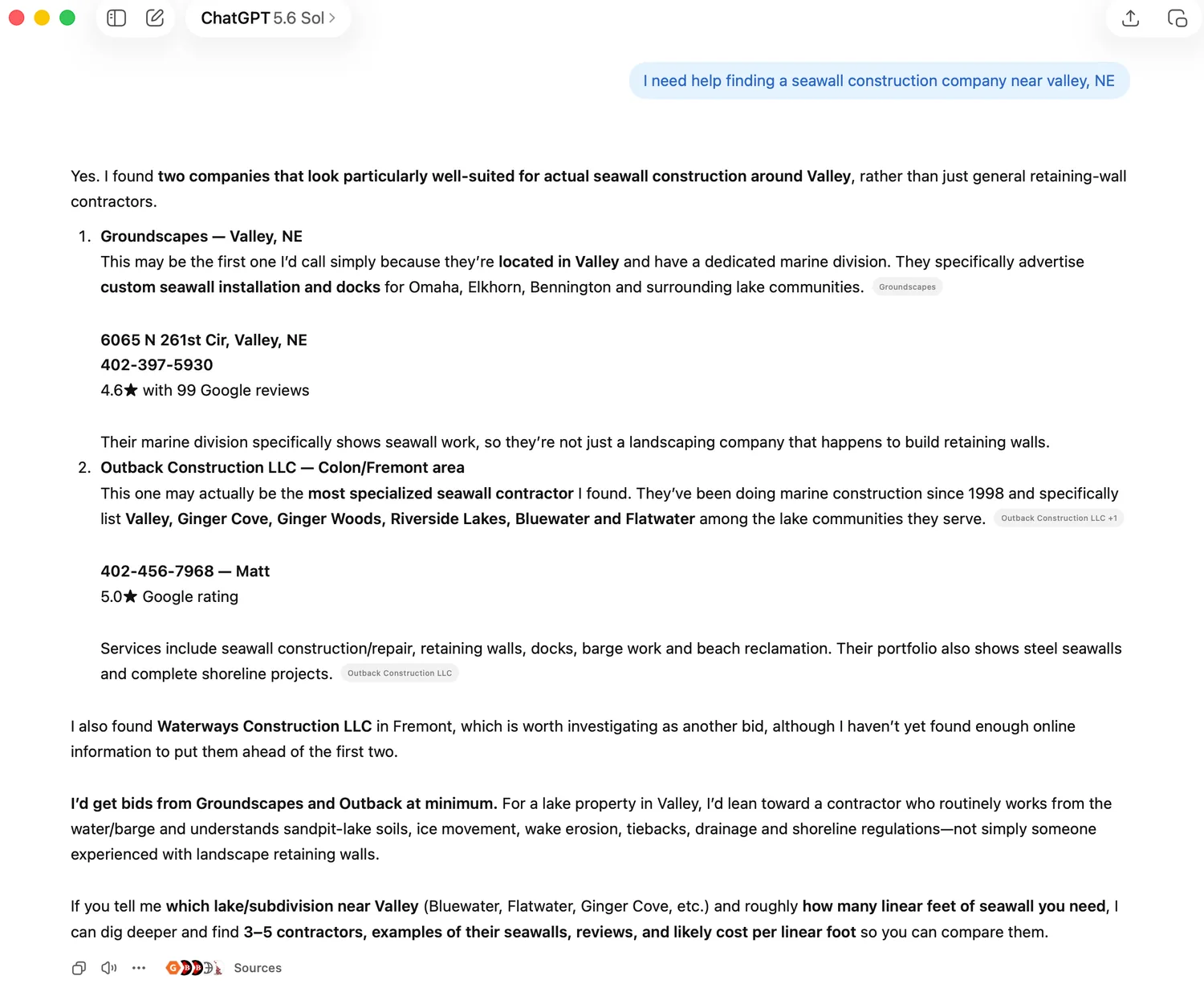
What ChatGPT actually returned
"This one may actually be the most specialized seawall contractor I found. They've been doing marine construction since 1998 and specifically list Valley, Ginger Cove, Riverside Lakes, Bluewater and Flatwater among the lake communities they serve… 5.0★ Google rating."
— ChatGPT, recommending a business whose site we built
That's the shift, in one story: your customers are increasingly asking AI to recommend a business instead of searching for one themselves. And when the AI answers, it names two or three companies — not ten. If it doesn't know you exist, or can't understand what you do, you're invisible to a fast-growing slice of buyers, no matter how good your Google ranking is.
The good news: getting found by AI search is learnable, most of your competitors haven't started, and the same work that earns AI citations also strengthens your traditional SEO. This is a practical, step-by-step guide to getting your business found — and cited — by ChatGPT, Perplexity, and Google's AI Overviews.
What "AI search" actually means
"AI search" is the umbrella term for tools that answer a question directly instead of just handing you a list of links. The ones your customers are already using every day:
- ChatGPT. Hundreds of millions of people use it every week, and it now browses the live web to answer questions like "who's the best HVAC company near me?" — complete with names and sources.
- Google AI Overviews (and AI Mode). The AI-written answer that now sits at the very top of a huge share of Google searches, above the normal results. It summarizes an answer and cites a handful of sources — often before anyone scrolls.
- Perplexity. A fast-growing "answer engine" built around AI that always shows its sources — so being one of those cited sources is the entire game.
- Gemini, Copilot, and the rest. Baked into Android, Windows, and Microsoft's tools, quietly answering questions for millions more.
They all work the same way at a high level: understand the question, pull from trusted sources across the web, synthesize a single answer, and cite a few businesses or pages. Your job is to be one of the sources it trusts and cites. That practice has a name now — GEO (Generative Engine Optimization), sometimes called AEO (Answer Engine Optimization).
Why this matters right now — not "someday"
Two things are happening at once. First, more searches end without a click, because the AI answer at the top gives people what they needed. Second, more people are skipping Google entirely and starting their research in ChatGPT or Perplexity.
Put those together and the math is simple: the businesses that get named in the answer win the customer, and everyone else loses the click before it ever happens. Ranking #4 on Google used to mean you still got some traffic. Being the business AI doesn't mention means you get nothing — the buyer already has their shortlist.
How AI decides which businesses to recommend

AI engines aren't magic, and they aren't guessing. They favor businesses whose online presence is:
- Clear and well-structured. Content written in plain language, organized around real questions, with the answer stated directly — not buried under marketing fluff.
- Understandable as an "entity." The AI needs to confidently know what you are, where you are, and what you do. That means your name, location, and services described consistently everywhere it looks.
- Backed by consensus. AI trusts what many independent sources agree on. If your Google Business Profile, your reviews, directories, and your own site all tell the same story, the AI believes it.
- Fresh and factual. Current information, accurate details, no contradictions. Stale or conflicting facts make an AI hesitate to recommend you.
- Technically readable. A fast, clean site the AI's crawler can actually access and parse. If your pages are slow, broken, or blocked, you're invisible before the content even matters.
The playbook: 9 steps to get found by AI search

1. Make sure AI can actually read your site
Everything else depends on this. AI crawlers read your HTML — so if your site is slow, buries its content behind heavy scripts, or hides text in images, the AI struggles to understand you. A fast, clean, well-structured site isn't just good for humans and Google; it's the price of admission for AI search. This is the single most common reason a good business gets skipped.
2. Answer the real questions people ask
AI search is powered by questions, so write like you're answering them. Use the actual questions your customers ask as headings — "How much does a seawall cost?", "Do you offer emergency service?" — and answer each one clearly and concisely in the first sentence or two, before you elaborate. This is exactly the format AI pulls into its answers.
3. Add structured data (schema)
Schema is code that spells out, in a language machines read perfectly, exactly what your business and pages are: your name, address, phone, hours, services, reviews, and FAQs. Marking up your site with LocalBusiness, Service, FAQPage, and Review schema removes all ambiguity — you're handing the AI the facts instead of hoping it infers them correctly.
4. Build a consistent business "entity"
AI stitches together a picture of your business from everywhere it appears. Make that picture consistent: a fully-filled-out Google Business Profile, and identical name, address, and phone number across your site, directories, and listings. Every inconsistency — an old address here, a different phone there — chips away at the AI's confidence to recommend you.
5. Earn mentions and reviews across the web
AI trusts consensus, and nothing builds consensus like reviews and mentions. A steady stream of genuine Google reviews, plus mentions in local directories, roundups, and press, tells the AI that real people vouch for you. In our seawall example, the 5.0★ rating and the specific communities the company served were exactly what tipped ChatGPT toward recommending them.
6. Publish genuinely useful, specific content
Thin, generic pages don't get cited. Depth and specificity do. Write from real, first-hand expertise — the details only someone who actually does the work would know. Google calls this E-E-A-T (Experience, Expertise, Authoritativeness, Trust), and AI engines lean on the same signals. Specific beats broad every time.
7. Keep it fresh and factual
AI is cautious about recommending businesses based on stale or contradictory information. Keep your hours, services, and pricing current, put visible "updated" dates on your content, and make sure the facts match everywhere. Fresh, consistent, accurate information is a green light.
8. Don't block the AI crawlers
You can't get cited if you've locked the door. Make sure your site allows the major AI crawlers — like GPTBot (ChatGPT), PerplexityBot, Google-Extended, and ClaudeBot — in your robots.txt. Many sites block these by accident (or by an old default), and quietly disappear from AI answers as a result. A clean sitemap helps the crawlers find everything you've published.
9. Measure whether you're being cited
You can't improve what you don't check. Ask the AIs directly — search for your services the way a customer would ("best [your service] near [your city]") in ChatGPT, Perplexity, and Google, and see whether you show up. Then watch your analytics for referral visits from chatgpt.com and perplexity.ai; that traffic is small today and growing fast, and it's the clearest sign the work is paying off.
Common mistakes that keep you invisible
- A slow, heavy website. If it's painful for a human, it's worse for a crawler on a schedule.
- Inconsistent name, address, or phone number across your site and listings — it makes the AI unsure you're even one business.
- No schema, no FAQs, no structure — leaving the AI to guess instead of telling it the facts.
- Ignoring reviews. They're one of the loudest trust signals AI has.
- Accidentally blocking AI crawlers and never noticing you've gone dark in AI answers.
- Thin, me-too content that says nothing only your business could say.
Your AI-search checklist
- ✅ Fast, clean site an AI crawler can read
- ✅ Content organized around real customer questions
- ✅ Structured data (LocalBusiness, Service, FAQ, Review)
- ✅ Fully-completed Google Business Profile
- ✅ Consistent name, address & phone everywhere
- ✅ A steady stream of genuine reviews
- ✅ Deep, specific, first-hand content
- ✅ AI crawlers allowed in robots.txt + a clean sitemap
- ✅ A habit of checking whether AI actually cites you
Where this is heading: agentic AI

Right now, AI recommends. Soon, it will act. "Agentic" AI — assistants that don't just answer but book the appointment, request the quote, or make the purchase on a person's behalf — is arriving fast. When a customer's AI agent is the one filling out your quote form, your website has to be something a machine can read and navigate flawlessly, not just something a human can squint at.
The businesses that make themselves easy for AI to understand today are the ones AI will be able to transact with tomorrow. This isn't a trend to watch from the sidelines; it's a head start you can take right now.
The bottom line
Your next customer may never see a search-results page. They'll ask an AI, get a shortlist of two or three businesses, and call the first one. Getting on that shortlist isn't luck — it's the sum of a fast, readable site, clear question-and-answer content, structured data, a consistent presence, and real reviews. Do the work, and you become the answer instead of an also-ran.
Want to know how AI-ready your site is today? Our free website audit grades your AI readiness — along with your speed, SEO, and local search — in about a minute, with a specific fix for every gap. Book a free strategy call and we'll map exactly what it takes to make your business the one AI recommends.
Frequently asked questions
What is AI search optimization (GEO)?
AI search optimization — often called GEO (Generative Engine Optimization) or AEO (Answer Engine Optimization) — is the practice of making your business easy for AI tools like ChatGPT, Perplexity, and Google's AI Overviews to understand, trust, and cite when they answer a customer's question. It overlaps heavily with good SEO but focuses on being named in the answer, not just ranking in a list.
How do I get my business to show up in ChatGPT?
Make your site fast and readable, answer real customer questions in plain language, add structured data, keep a consistent and complete Google Business Profile, earn genuine reviews, and make sure you aren't blocking AI crawlers in your robots.txt. ChatGPT pulls from the live web and from trusted sources, so the more clearly and consistently your business is described online, the more likely it is to recommend you.
Is AI search optimization different from SEO?
It's a close cousin, not a replacement. Almost everything that helps you get cited by AI — speed, structure, schema, reviews, consistent business info, useful content — also helps your traditional Google ranking. The main shift in mindset is optimizing to be the answer an AI gives, which rewards clear, direct, question-based content and machine-readable data even more than classic SEO does.
Do I need to block or allow AI crawlers?
If you want to be found by AI search, you should allow the major AI crawlers (such as GPTBot, PerplexityBot, and Google-Extended) in your robots.txt. Blocking them keeps your content out of AI answers. Some businesses block them for content-protection reasons, but for most local and service businesses, being cited by AI is a marketing win worth having.
How long does it take to get found by AI search?
There's no fixed timeline, but the technical foundation — a fast, readable, well-structured site with schema and a complete business profile — can be in place in weeks, and AI tools that browse the live web can begin reflecting those improvements relatively quickly. The trust signals, like a steady stream of reviews and mentions, compound over months. The businesses that start now build a lead that's hard to catch.
Reading about it is step one. Doing it is step two.
Book a free strategy call and we'll tell you exactly what'll move the number for your business.